Figura (figure) is an Italian word of Latin derivation that shares the very same etymology with fingere (to pretend), which used to mean to mould, originally. Its primary meaning concerns the appearance of something, but it is also adopted in physics, geometry, and often art — as ‘Landscape with figures’ exemplifies.
However, when it comes to Mara Palena’s work, the most immediate meaning that comes to my mind is to dance, as figure (figures) — and I thank Treccani’s accuracy — also stand for “a series of harmonious movements in time and space, either of a whole person or just one body part (e.g. arms, legs, torso, head, and so on). Each figure is governed by the laws of cadence, rhythm, and proportion, and bears a particular name.”
Such harmonious movements are not to be seen here: you will only glimpse, behind opaque glass and grill-protected openings, a few gestures. Or rather, each of us will see different things by observing this choreography’s figures, where we are the actual dancers. We dance in space, we move to the sounds of the artist’s memory, trying to interpret the unknown, recognize words, identify sources.
When there’s nothing to look at, you may see yourself. You may listen to the sound of the sea despite the city out there, feel your feet wetting, and hear the waves crashing on the rocks. What’s the difference between your body and those rocks?
A seagull afar. I look at the ceiling and see a plane. Crickets chirp outside the window, yet it’s November in Milan. I always hear them as I cycle along the disused tram tracks; they hide amid the fallow grass, they hide in my hair. I move my hands messily to try to shoo a fly, push your voice away, push the memory of you away. One two three four five six seven. I’ve even searched for hypnotic techniques to try to sleep, to shut off my thoughts, as sorry as I am that you are alone and sad. Hearing you laugh comforts me, lifts me up, but that accordion is a bad omen, the even stronger misery of your loneliness. It’s the misery for the passing of time, of people, for that amazement, carefreeness, courage you only have in your teenage years.
And if a straight line is an infinite set of aligned points, with neither beginning nor end, extending endlessly in both directions, having one dimension only, the length, always straight and with no thickness, then I know that, as I follow this choreography, I’d rather go astray. I’d rather go astray.
Marta Cereda
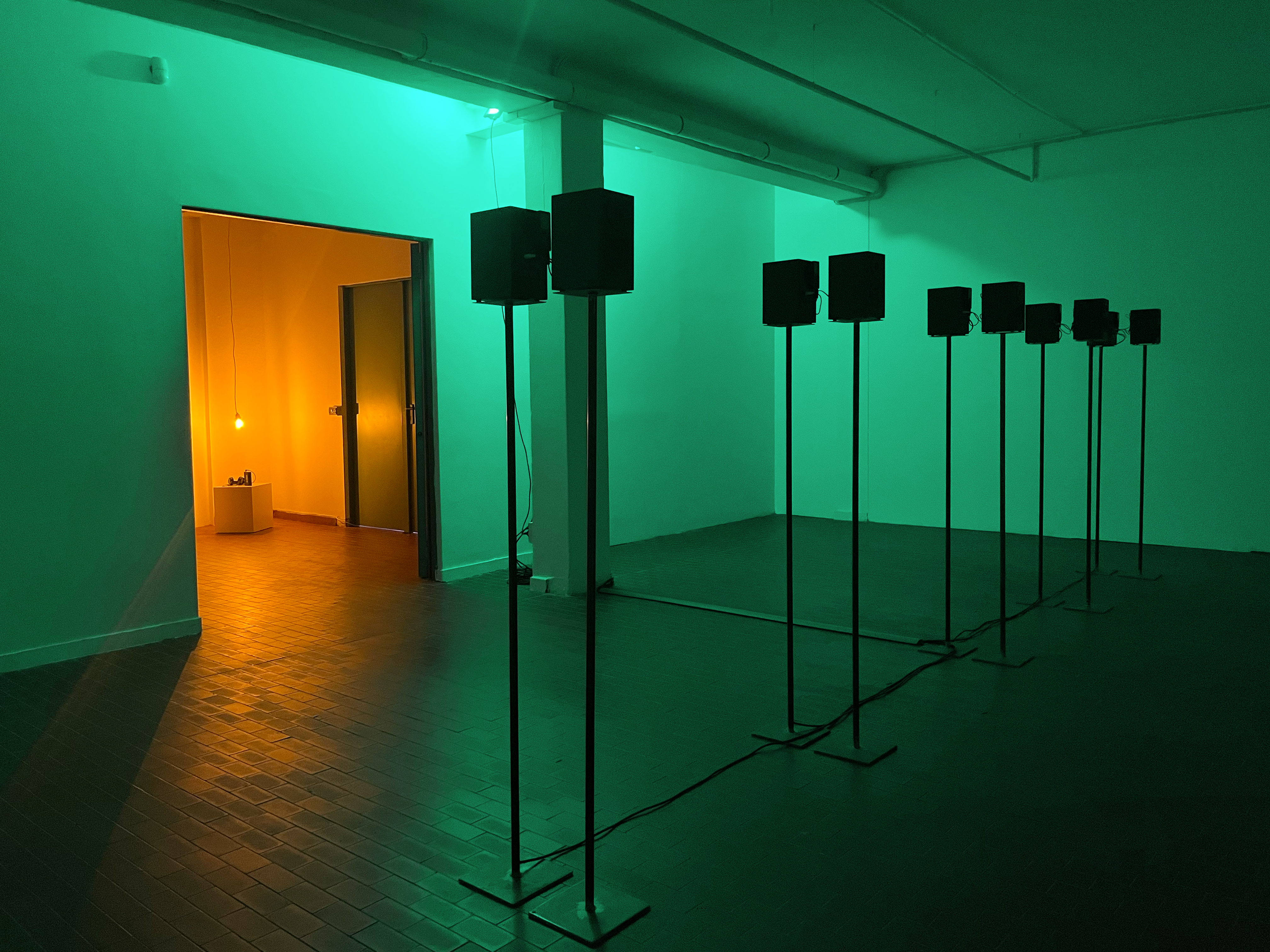
Versare il mare nel mare fig. 01–05, Sound installation, loop, 2023
Thanks to Jessamine-Bliss Bell for the use of the voices from the project A Study On Behaviour, and to Alessandro Bigazzi for his remixes.
Fig. 01–05 permeates the exhibition space with varying intensity. An acoustic journey that questions the notions of memory, individuality, authorship, and time. It is an immersive installation, inevitably blended with what unfolds in the present. The voices the artist has gathered over time overlap backstage recordings, performative readings, sounds captured in a Japanese temple, and even a montage generated through artificial intelligence, which translated into notes and set to music a series of private conversations. The audience’s real-time own perceptions and experiences overlie this journey.
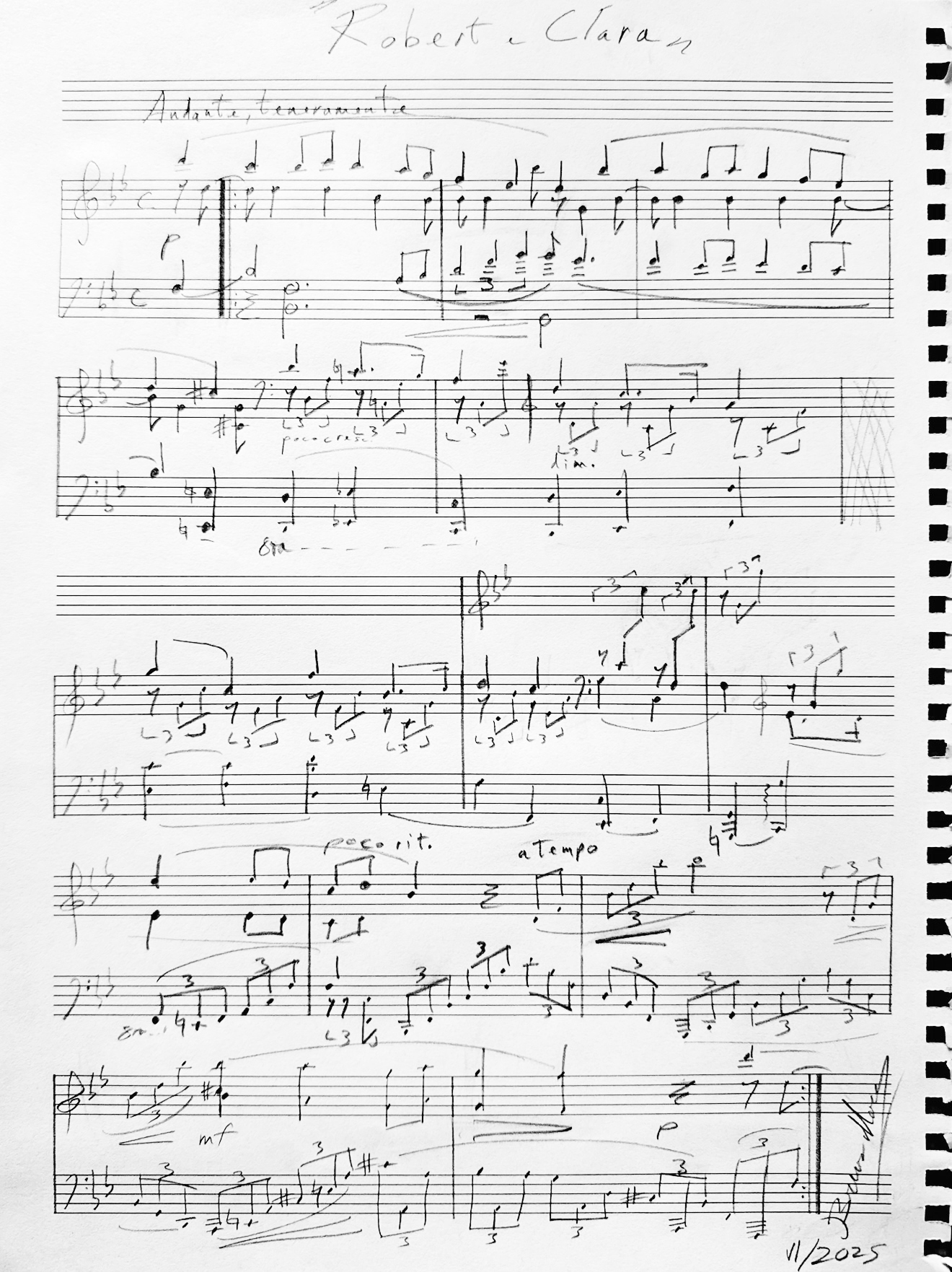
Versare il mare nel mare fig. 07, Sound installation composed and performed by Bruno Mereu, 60 min loop, 2025
Fig. 07 is the seventh stage of an acoustic journey that reflects on memory, individuality, authorship, and time. By continuing to re-elaborate the work, the artist feeds AI with a series of text messages from a lost love, creating a track reminiscent of Robert Schumann’s compositions.
Figure 07 arises from a collaboration with composer and pianist Bruno Mereu, who composed an intimate soundscape inspired by two pieces by Clara Wieck and Robert Schumann — Prelude, Op. 11, No. 2, and Träumerei — rendering love communication as both a personal and universal experience. The piece unfolds in a loop that serves as a constant beat, evoking the persistence of a feeling and its transformative power. The two melodies intertwine in an affectionate yet melancholic dialogue, to which Mereu has added commentaries and transitions inspired by Schumann’s narrative and visionary style. With each repetition, time expands; the dialogue transforms into an echo, the sound into memory.
Day, Night and Everything Against It – Versare il mare nel mare fig. 08, Sound installation, cassette player, loop, 2025
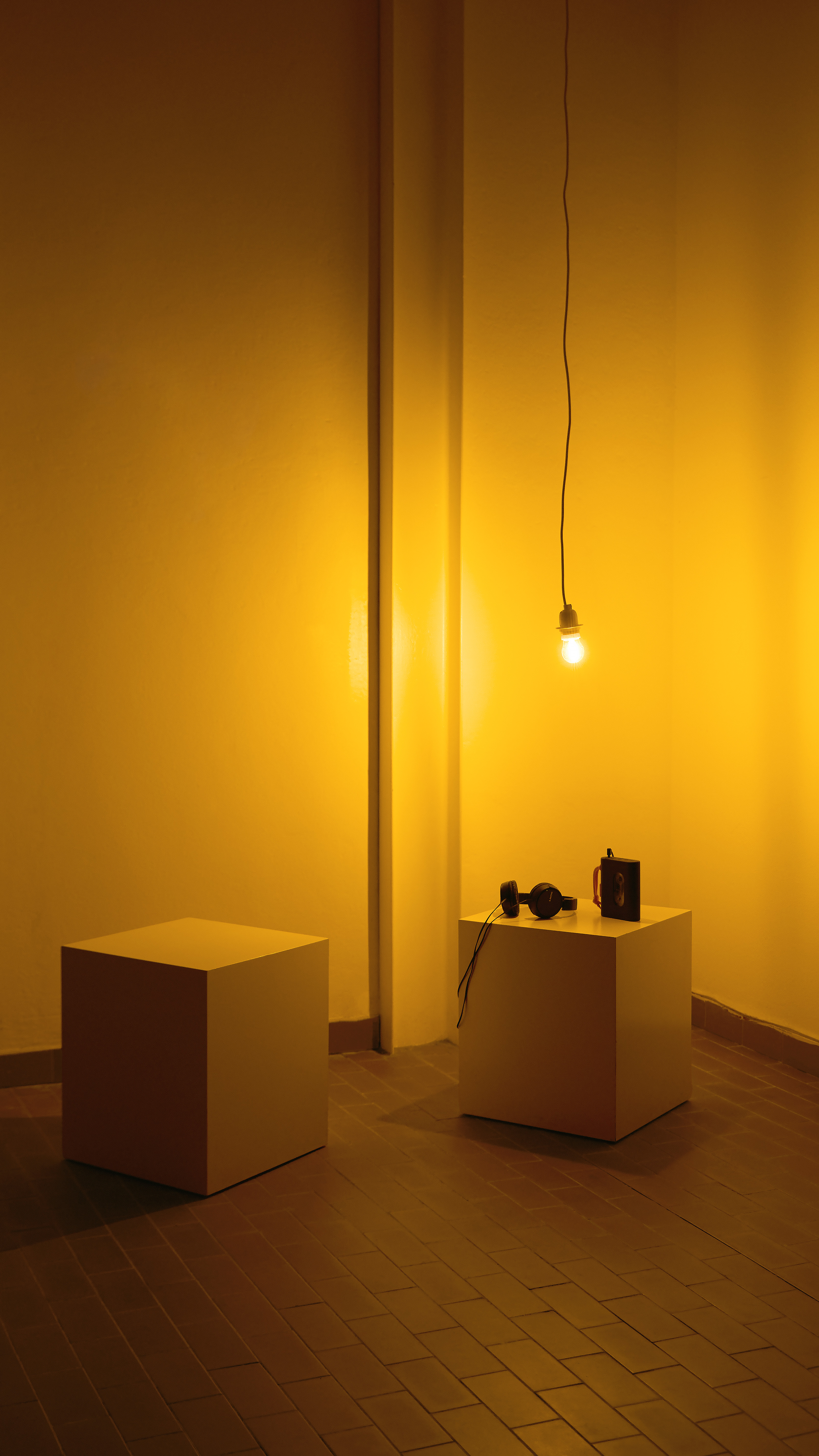
Fig. 08 re-elaborates home videos’ fragments from the artist’s childhood by transforming them into a sound composition that explores the permeable boundary between memory and fiction. Recorded on cassette and portable in a Walkman, the work’s memories overlap the texture of the magnetic tape, creating a fragmented soundscape tied to the idea of movement.
Oikeiôsis fig. 0208, Glass-mounted installation, 15 × 65 cm, 2023
Oikeiôsis fig. 0136, Glass-mounted installation, 15 × 65 cm, 2023
Oikeiôsis fig. 0300, Glass-mounted installation, 70 × 98.5 cm, 2023

Oikeiôsis is a project that explores the unconscious, spanning from the artist’s childhood to the present. By altering images, words, and sounds — and reconstructing new forms and memories — it moves from an intimate and personal toward a universal dimension, examining individual memory, fragile vulnerability, and the attempt to preserve remembrance against the passage of time.
The exhibition took place in Milan as part of Sunnei’s MOMENTO 06 event.
 Mara Palena