Recontemporary, on the occasion of Olimpia Biennale d’Arte Contemporanea in Alta Langa, promoted by Lunetta 11and organized by Unione Montana Alta Langa, presents Listen to me, why is everything so hazy?, a site-specific installation by Mara Palena, hosted in the Confraternita di San Sebastiano in Paroldo.
“Passion is solitude multiplied a thousand times over, but a solitude that, as if surrounded by a thousand glittering mirrors, seems to expand itself and become a world that encompasses everything.”
The Revolt of Eros: On Love and the Type of Woman, Lou Andreas-Salomé
San Sebastiano becomes a place to explore love—a threshold, a space of suspension: an intimate, immersive, and profound experience, a poetic reflection on time and transformation.
The installation’s title is inspired by Lilac Wine, a song made famous by Jeff Buckley and originally written by James Shelton in 1950, reinterpreted many times as a tale of lost love and the ensuing despair, evoked through the image of lilac wine that clouds reality.

With an intimate and poetic gaze, Mara Palena composes an immersive path weaving together video, sound, light, and atmosphere. As one moves along the nave, time becomes a living substance—shaping bodies, traversing affections, layering identity. It fades, it changes, it evolves. Like lilac wine, which in the song clouds perception and dilutes reality, the installation moves through memory, stratification, and disorientation, allowing time itself to guide the experience.
The relationship with the gaze of the other plays a central role in this process: a mirror in which we recognize or lose ourselves, a lens through which we shift, a bridge that links body, space, and identity.
Love, like time, becomes a transformative, unstable, cyclical force. The apse—once a space of prayer—now hosts memory, inviting us to engage in dialogue with what was and what still resonates: the sound of a voice, an echo of love, a memory in transformation.
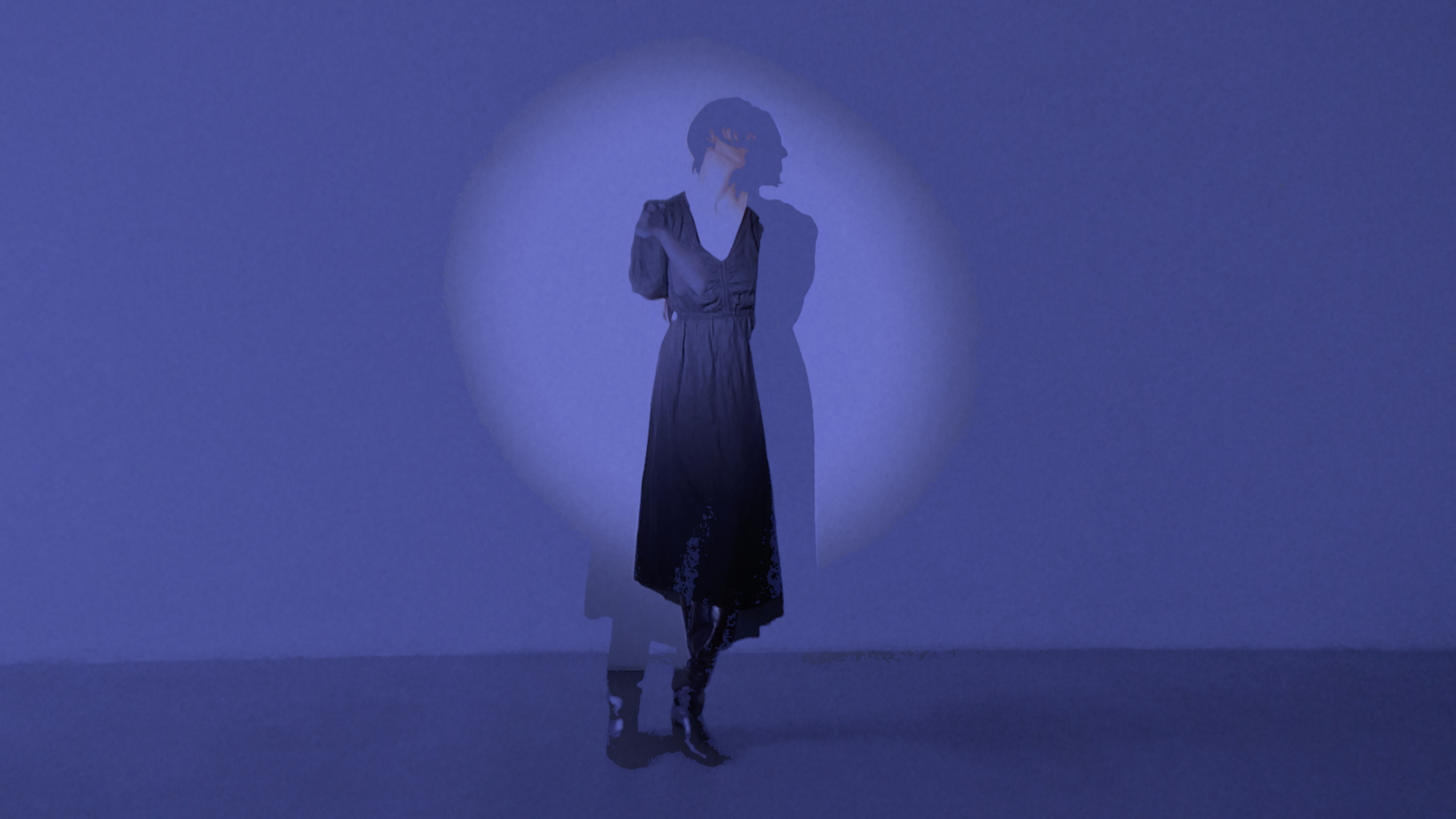
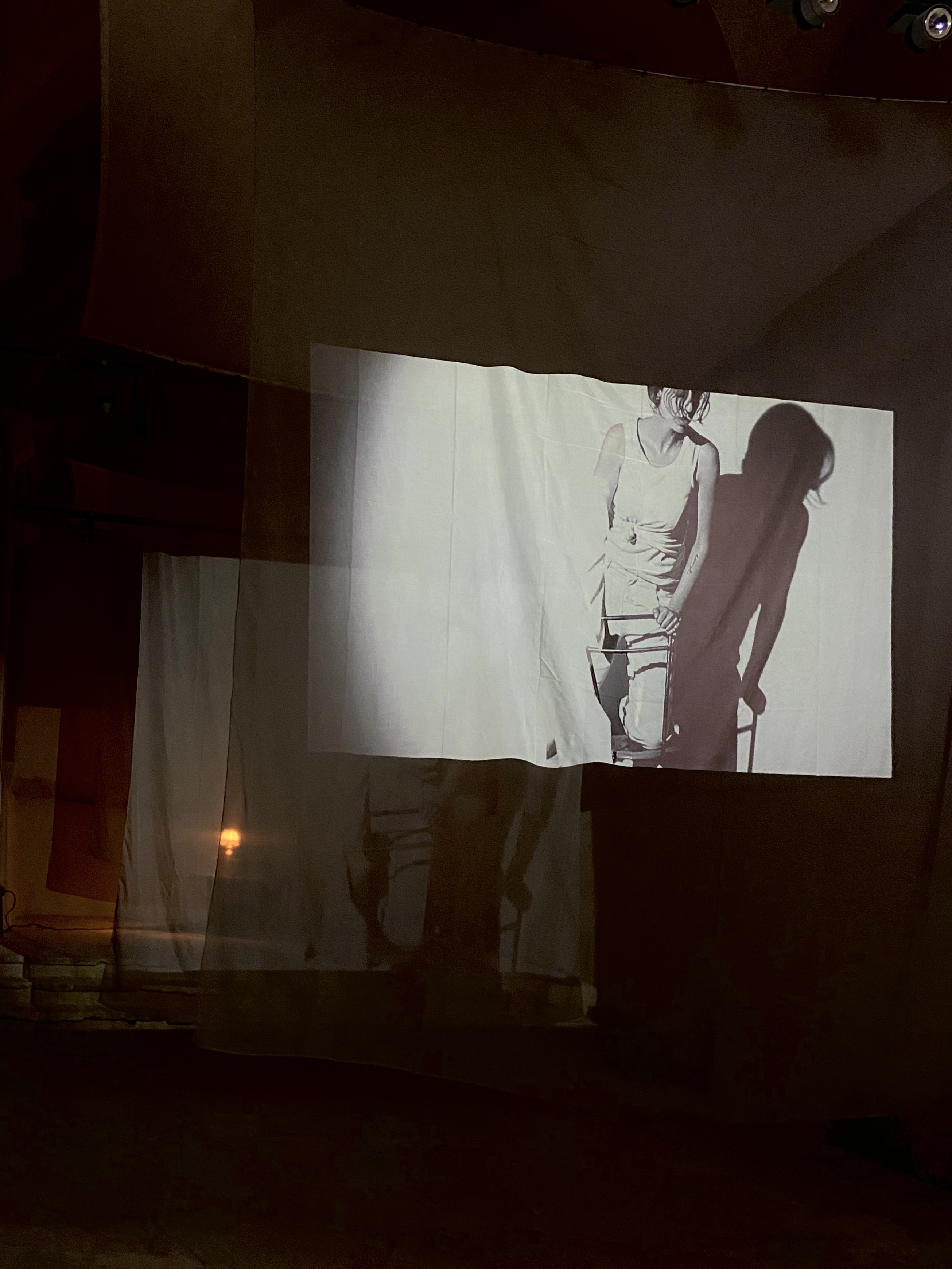
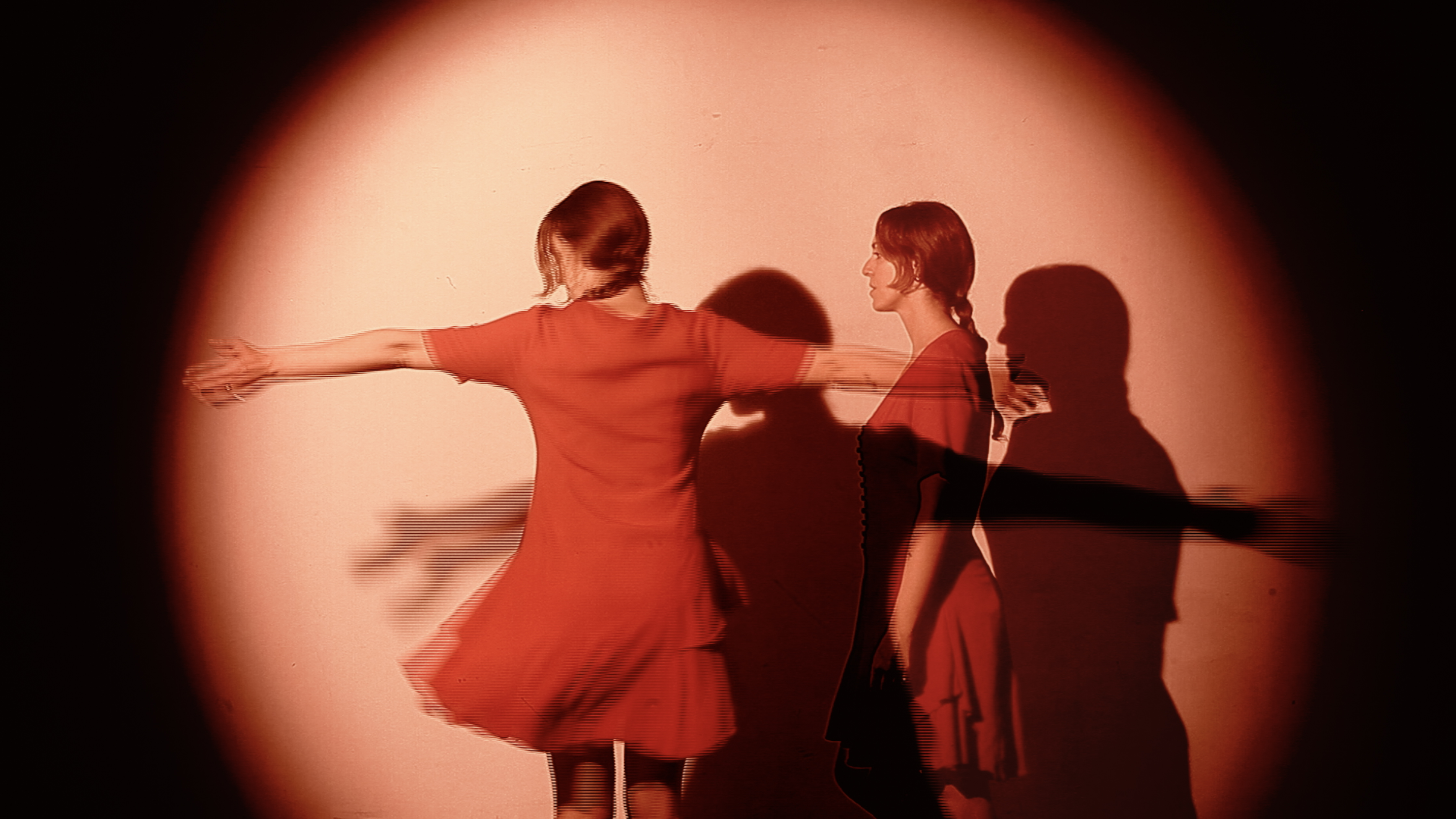
Inside the Confraternity—a place that by its very nature harbors silence and memory—the work takes on a deeper dimension. The boundary between visible and invisible, presence and absence, stillness and motion becomes ever thinner.
Semi-transparent fabrics, fragments, layers, memories, converge into a sensory score that invites us to get lost, to recognize ourselves, to listen, to remember.
Here, the body is not merely a container, but a living archive: a space of emotional accumulation, a place of memory and projection. Every gesture, every posture, every silence becomes a form of language.
Versare il mare nel mare fig. 07, sound installation composed and performed by Bruno Mereu, 00:60:00 loop, 2025
Versare il mare nel mare fig. 07 is the seventh chapter in a sonic journey reflecting on memory, individuality, authorship, and time. Continuing to rework the piece, the artist feeds an AI with a series of text messages from a lost love, producing a composition reminiscent of Robert Schumann’s works.
Figure 07 was born from the collaboration with composer and pianist Bruno Mereu, who created an intimate soundscape inspired by two pieces by Clara Wieck and Robert Schumann – Prelude Op.11 No.2 and Träumerei – offering a portrayal of romantic communication as both deeply personal and universally shared.
The piece unfolds in a loop, like a steady heartbeat evoking the persistence of feeling and its transformative power. The two melodies intertwine in a tender, melancholic dialogue, enriched by Mereu’s additions of comments and transitions inspired by Schumann’s visionary and narrative style. With each repetition, time expands: the dialogue becomes echo, the sound becomes memory.
The composition enters into dialogue with the video work Valeva la pena rischiare di perdersi and its two central figures.
Valeva la pena rischiare di perdersi, video installation, 00:60:00 loop, 2025
This expansive, disjointed projection becomes an exploration of movement and stillness, generating a visual rhythm that unfolds over time without rigid synchrony. This temporal fragmentation invites the viewer to perceive time non-linearly, immersing them in a suspended dimension between present and memory.
Images of running through empty space, repeated gestures, and still scenes in a bare environment evoke a continuous cycle of searching, loss, and rebirth. The use of semi-transparent, delicately veiled fabrics amplifies the ephemeral and fragile nature of these themes, creating plays of light and shadow that multiply the perception of both space and body.
These veils act as permeable thresholds—symbols of crossing and transformation—rendering the invisible visible and suggesting permeability between interior and exterior, presence and absence.
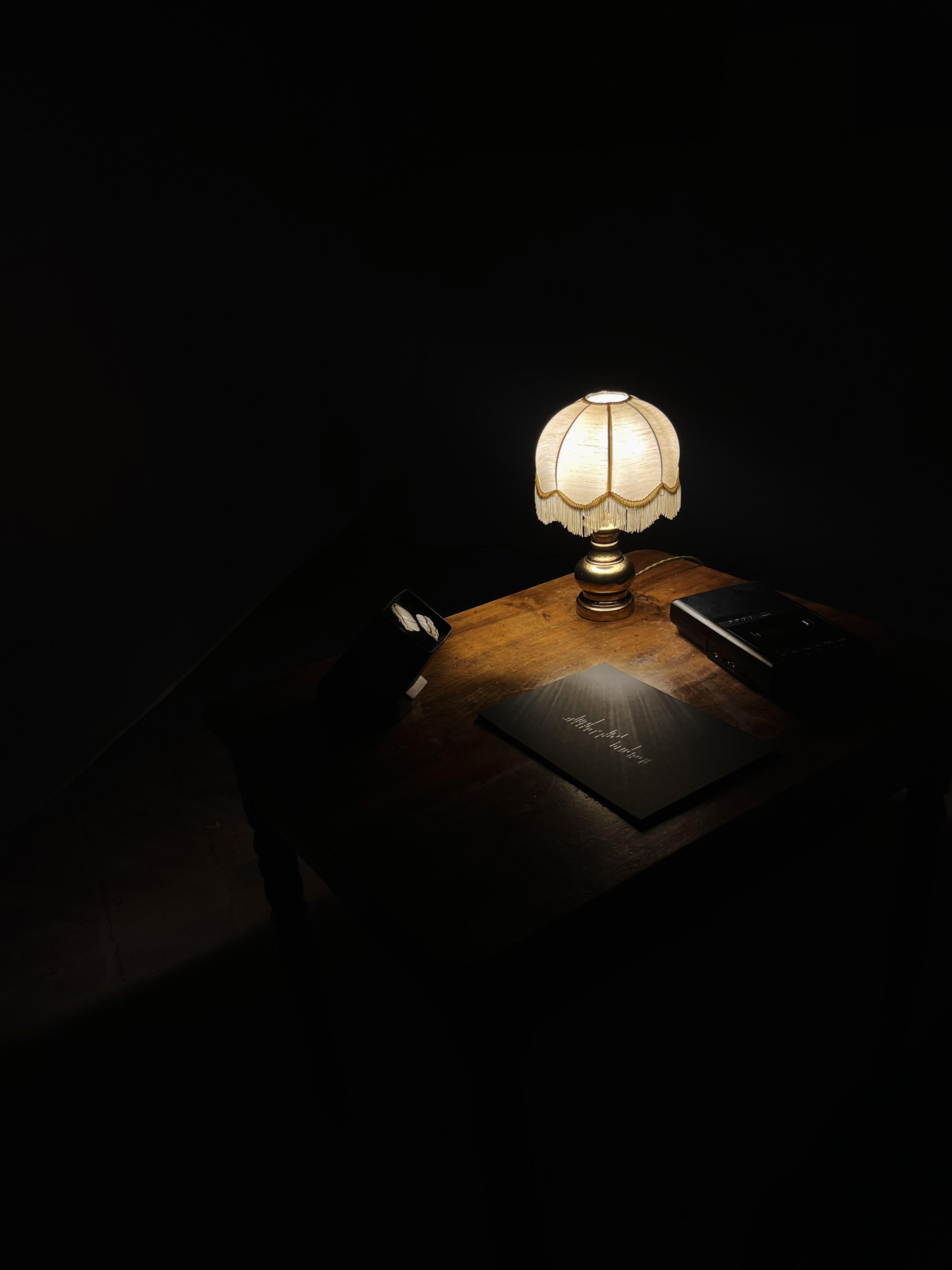
Shadows of places, the moon, and a hazy glass, sound installation, 00:60:00, 2025
The work presents a cut-up of words extracted from SMS messages belonging to a vanished love.
These fragments, decontextualized and reassembled, form a discontinuous and intimate narrative in which each word becomes charged with ambiguity and interpretive possibility. The intervention adds a deeper layer of reflection on the intimacy of contemporary communication and the act of remembering, giving the viewer space to linger on the emotional nuances that emerge from what remains: half-phrases, pauses, silences.
The sound fragments act as an interior monologue—a secret conversation no longer addressed to a specific other, but relived within the listener’s own body and mind. A love that no longer exists, yet continues to manifest through residual traces, never identical, like the echo of an absent presence.
Language becomes a way to transform loss, giving shape to a disordered and living memory—on the threshold between remembrance and reinterpretation, between the real and the imagined.
I wished I was, performance documentation, 00:19:39 loop, 2022
This projection is part of a 2022 installation in which the video alternates with technical images drawn from the artist’s private archive, creating a visual stream of consciousness through which she elaborates on the final chapter of Ulyssesby Joyce, interpreting Molly Bloom.
 Mara Palena